

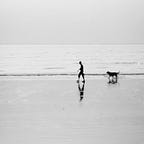

Today, let’s go for a beach walk to promote a wider perspective, divergent thinking, and the generation of novel ideas. Coastal environments offer a distinctive form of multisensory immersion that shifts cognition toward broad, exploratory modes rather than narrow, focused ones. From a neuroaesthetic perspective, the perception of vastness and openness offered by beach and horizon scenes is closely linked to experiences of awe and contemplative engagement. Expansive visual fields tend to activate the brain’s reward systems while quieting self-focused mental chatter, allowing attention to widen and thinking to become more fluid. The blue tones and gentle gradients of the seascape, often associated with calm and spatial depth, work together with sound and bodily sensation to support a more regulated, parasympathetic state. Repetitive but not perfectly predictable, the rhythmic sound of ocean waves lowers vigilance demands and reduces novelty processing, encouraging perceptual settling rather than active scanning. The frequency distribution of wave sound is similar to pink noise, which has been shown to promote a calm, sustained mode of attention. Although the cadence of ocean waves does not correspond directly to the alpha range of 8–12 Hz, it can entrain slower bodily rhythms and thereby support the emergence of alpha activity, a brain state associated with relaxed wakefulness, soft fascination, and insight generation. Embodied attention, adaptive motor control, and psychological regulation are supported by the somatic experience of walking on sand, particularly barefoot, which engages proprioceptive and somatosensory systems more intensely than firm-ground walking. Taken together, the visual, aural, and somatic sensory conditions of the beach distinguish it from more enclosed natural settings that prioritize attentional restoration, making it particularly well suited to expansive cognition, creative ideation, and the quiet incubation of insight.
This type of walk is best practiced in the morning or late afternoon, on a beach that is sparsely populated enough to allow for an even walking pace for at least forty minutes. I prefer warmer temperatures, when it’s possible to walk barefoot along the shoreline where the sand is damp and slightly firmer. In any season, sun protection is worth considering. The particular walk I’m offering today follows a simple to-and-fro, and I often find that sunglasses or a sun hat are useful when walking more toward the sun.
Now, you have two options. One is simply to take a long beach walk, about twenty minutes out and twenty minutes back, and let the environment do the work on its own. The other is to join me in this audio, where I offer minimal guidance designed to support reflection on a relational or ethical matter, something involving how you’re relating to another person, or how you’re holding a situation, without trying to analyze or resolve it.


